Showing posts with label fine motor skills. Show all posts

Friday, 23 January 2015

Key Marking

J has a problem with locating things.  As mentioned in this blog, he likes the colour yellow. A lot.  Wandering around Homebase the other day, a small pot of Rustoleum Painter's Touch gloss finish in Bright Yellow was spotted... and, looking at the materials it can be used on, metal is covered.  So, a 20ml pot was bought (for £1.99).  We would paint the keys we need to find quickly - key covers have been tried in the past but they never last long.


Today, we assembled our equipment - old newspaper, small paintbrushes, keys and paint.

Covering the table with newspaper, the paint shaken and the correct key identified.

The key was painted yellow (we were lazy and didn't take it off the key ring)...


...and left to dry in the sunshine.

Once fully dry, it took about an hour, we had two sets of keys with a lovely bright yellow key for us to spot - effectively, a visual "USE ME" for all of us to see.

As shown in our pictures, we also use yellow wristbands on key rings as these allow the keys to be seen and held easily.  J's getting used to using keys when we go on dog walks - locking the door and keeping the keys safe - and having a wristband means he worries less about losing them.  Attaching them to his wrist gives him the security to know he has the keys with him and also has them readily available when arriving back at the door.

Thursday, 15 November 2012

Modelling with Meccano

Keeping things interesting for J whilst trying to improve his manual dexterity and co-ordination is a daily task.  Finding items and activities that appeal to him is all important (we have used therapy putty many time in the past, blogged about his Hama beading and he is keen to Lego whenever he can).

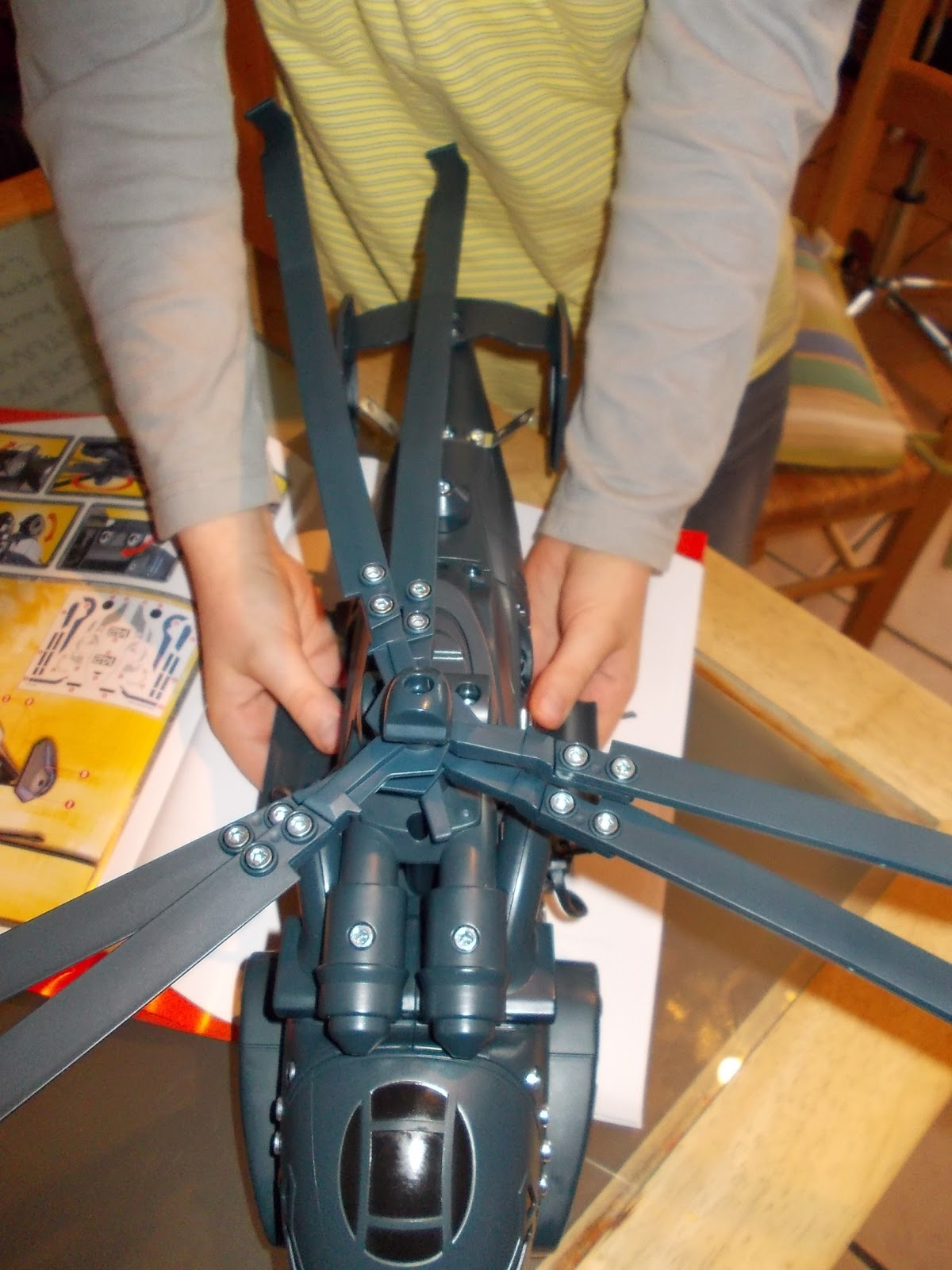
We were lucky enough to be sent some meccano for J to review.  He had looked on the meccano UK website and chosen a Gears of War Helicopter - King Raven which was the model he was keen to assemble as soon as he set eyes on it.  Meccano was a good choice as it has small parts to deal with, over 300 in this set, and clear instructions to follow which help J with his planning skills.
True to form, J laid out all the pieces and inspected the manual to start with.  Then building commenced.  This was a task which took us a few days to complete and was a collaboration where J was project managing me when his dexterity let him down.  I am pleased to report, however, that towards the end of the build, J was able to complete most of the "structural assembly" himself.
J opened the plastic bags containing the parts with scissors and what follows is a montage of the build... and the comments are from J.
That's looking like it should...
These are a bit fiddly but the slots are good.
Nearly got the front wheel attached.

What's the next step?
It's looking good.
This is easy to follow...
...this is a bit more challenging!
It's looking like we're nearly done.
Ta dah!
This is bigger than I expected.
J loved working, over a number of days, on the model building and is looking forward to assembling the Space Chaos Heart of Darkness when he gets the chance!  He's particularly keen as it has "real life, working lights".   This set looked rather a challenge at the outset (having many pieces and almost 70 instructions) but J said of the whole undertaking "It was amazing and all my pals will be shocked at the size of the model!"

Disclosure - We were sent the meccano for free but these are our own views and pictures.  No fee has been paid for this blogpost.  Many thanks to Liz and Meccano UK.

Sunday, 4 November 2012

Meandering through Motor 'skills'

Where to start with this post?  First of all, this is not a comprehensive guide into motor skills, as the title suggests, it will be a meandering account of things we've tried/are trying with J.  We embarked on the wanderings in the knowledge that with strong gross motor skills, fine motor skills follow and with that the seemingly all important handwriting will emerge.  The trouble for us is that with J his gross motor skills, at 12, remain poor (although they have improved greatly and he has worked long, and hard, to master things.)  There is so much to say and cover that bite-sized posts may be the only way to go.   We have tried/employed/practised many, many, many items/programmes/techniques in the hope of finding out what works for J.

J has struggled all of his life with handedness (this was touched on in an earlier post - What about Writing)... he showed no preference as a youngster so, given his other difficulties, it was agreed to encourage him to use his right hand.  Now, this has made little difference.  Being brutally frank, he is the opposite of ambidextrous, that is he is equally poor with both hands!  We now know this is called being 'ambisinistrous'.
As said in the aforementioned earlier post, J has had access to all types of pens, grips, writing slopes, white boards, therapy putty, paints, brushes, gross and fine motor games and exercises.  All to very little avail.  However, the facts remain that he has little stamina, holds implements at odd angles, cannot align his physical output with his mind's eye picture of what he wants to deliver... so you can imagine the frustration he feels.  In the family, we call this his frustration gap and we try to encourage him to keep putting pen to paper with simple dot-to-dots, line games, letter formation games and so on.

Some of the pens we have in our arsenal of handwriting tempters... he tends towards those with fatter grips and that can be corrected.  So, the frixion pen was a real find - it writes like a roller ball yet rubs out like a pencil.  The Stabilo s'move range are brilliant for reminding him where his fingers need to be to hold the pen/pencil.  And the selection of felt tipped pens he has used is vast.

Over the years, although he has poor hand eye co-ordination J has adored Hama beads and is a still a keen beader.  There has been the odd disaster when his masterpiece hasn't made it to the ironing board for fusing before a tremor has jerked the beads all over the floor.  He loves telling the story of when he was trying to open a packet of beads (5000 of them) and was tugging at the packaging whilst saying "Mum, can you help me open - oooooops!"  and lo!, there were 5000 beads spread far and wide across the floor. Whoops.  We both had to laugh but my goodness they can't half travel.

Naturally, he's also been very much into Lego and Meccano and comes up with some massively complex creations.  All of which have added to his fine motor skills and co-ordination/planning.  He has a huge collection of Lego... dreams of the stuff and talks about 'improvements' to the current range of models he's working on.  Lego is great for him... he gets to express himself, can (usually) do all his Legoing by himself and the models are quite sturdy so withstand any unexpected tremors.  Of course, sometimes a 'disastrous' failure happens and it will require immediate re-building of the model 'just the way it was'. Meccano is a bit more structured, the instruction leaflets great for planning and the skill required to use the bolt/nuts in situ is one he's starting to master.

Work on gross motor skills happens throughout every day.  J will catch and throw (socks usually) and can even bounce a mid-sized ball and walk with it a few steps now.  He will jump off steps (only up to 4) to get feedback and 'ground' himself.  He balances on a gym ball or physio roll (peanut) when he watches television so he knows where his body is... He's on the move all the time. In summer he will bounce on the trampoline. He has a swing seat indoors and loves to use that to calm down - but it also lets him know where his 'bits and bobs' are.  More to follow on this in a later post...

Sunday, 28 October 2012

Looking at Laces

Amongst other things, J finds laces on footwear extremely difficult to deal with.  The combination of fiddly-ness, lack of power in his hands and general poor coordination mean that laces are viewed by him with dismay.  Added to this, is the eternal problem of having to go to a shop to have his feet measured, going through the explanation/demonstration to the shoe fitter about his 'aggressive' orthotic insoles and then finding (hopefully) that there is just one pair of boots that meet all requirements - supportive ankle, big enough for orthotic, waterproof and with velcro fastening.  However, on most recent occasions, no shop has been able to supply us with a suitable 'footwear solution'.

In the past, the Clarks online ordering of boots and collection/purchase post-fitting in store has worked well - but not this time.  Boots are only available in the winter season and unfortunately they don't offer any boots in an H fitting which is required by J.  So, we had to find a different solution.  When J was seen by the podiatrist at Great Ormond Street Hospital earlier in the year, she suggested that Timberland boots were something we could try.  A quick internet search revealed a pair of these boots that met all requirements bar the velcro fastening.  The boots were ordered and collected, had their insoles removed and J's orthotics inserted.  It was looking positive as the insoles fitted the length of the boot well.  Then J shoehorned his feet into the boots (literally) - he finds using a long, from Ikea, shoehorn the best way to get his feet into boots.  Then came the laces.  He was not happy to see them but, with a little lateral thinking on my part, they became acceptable to him.

I sourced a couple of lace toggles/locks and cap/end covers. (search on ebay for cord locks or spring toggles).

Here's what I did.  I inserted the laces in a toggle, added an end cap and tied the lace ends before pulling the cap down.  Not a perfect solution to tying the laces but at least J can make a good attempt at putting his boots on himself and we can check the tightness/fit prior to going out.  Result.  Quicker for us all with J having his own way to manage putting boots on.

Sunday, 7 October 2012

What about writing?

It was obvious from an early age that J would find writing a chore. He never wanted to use crayons (although was happy to watch others do the colouring in as directed by him), frequently used implements in either/both hands and had no well developed handedness.  Given this lack of favouring of one hand over another, we took the decision, when he started in Reception class to encourage use of his right hand to write with.  It was quickly apparent that his fine motor skills were not great.  Seeing as his gross motor skills were also developing slowly, this should not have come as a surprise.  However, school were still adamant that he MUST learn to write... and quickly.  He was sent home with remedial worksheets, taken outside the classroom to complete work when the other children were playing (even though he was falling asleep and just could NOT do what was asked of him) and generally subjected to a barrage of hands on penmanship. Despite being diagnosed with Developmental Co-ordination Disorder (dyspraxia) during his Reception year the teacher's insistence he carried on with handwriting was ever present.

None of this helped.  No matter how hard he tried, J remained slow to form letters, had trouble with manipulation of writing implements (and scissors), complained of fatigue and was, in the end, completely turned off handwriting.  As I was (and still am) a stationery collector with pens aplenty, we sought out all manner of different styles of pen and pencil.  Every type of pencil grip was trialled, we have writing slopes, cut out windows to reduce the area he has to write in, coloured note pads (crossbow education have a great range), paper with raised lines, squared pads, shaded writing books, the list is endless.  He tried short pencils (as this 'forces' a tripod grip), fat pens (to reduce strain) and textured pencils (so he could feel them better). Fat, light pens with a smooth writing action are favoured - so the Staedtler Mechanical pencil we found at the education show one year was a marvel.  It's fat, light and has a soft, thick lead together with a proper mechanical pencil action. It's also a bit yellow...  Bingo.  This is the implement of choice when pencil will 'do'.  When a pen is required then the Pilot Frixion range are a godsend... any errors can be removed and J finds the pens quite comfy to use with their defined grip area.

We supplied the school with an Alphasmart NEO for times when it was more important to get J's ideas down on paper than for him to use handwriting.  Again, none of it helped.  Even now, at 12, letters still have to be talked about - where does a "guh" go - and even his own name he cannot reliably write correctly.

So, what do we do to assist him?  Well, first off we took him out of school!  There you are, in one fell swoop he was much happier at not being forced to write "for no reason"...  he does write, by hand, thank you letters, short post cards and each day he does a small amount of handwritten 'work'.  He may write a shopping list (for me, as I am too busy to do it myself - he is helping me), a list of characters from Pokemon and their special powers, some ideas from Horrible Histories... you get the idea.  Stuff he wants to write or things that he feels have a purpose.  No more copying from a board/book/worksheet just to fill time.  He uses white board pens on our kitchen table when working on problems from the mathletics site.  There is a reminder sheet of how letter looks stuck to the underside of the glass, which reminds him of how to write each letter.

When he was first out of school we discussed a programme of letter formation with his Occupational Therapist.  She had found out that he didn't realise the space that each letter 'ought' to take up - that is there are ascenders, descenders and letters with both!  So, using a subject that interested him at the time, we linked each letter to a part of a volcano - those with ascenders went to the ash cloud, descenders the magma chamber and the rest were the cone.  This, together with doing a daily exercise using the Handwriting Without Tears programme we reinforced the idea of how letters are formed, where they 'go' and how they should look... it's a multi-sensory approach (although we had to amend it slightly as J can't bear the sound/feel of chalk but that's another story). 

I guess there is no end to this post as J still struggles to write, has very low stamina and is poor at forming words.  He uses technology as much as he can.  Produces mindmaps to encapsulate his thoughts and ideas and will dictate to me should he feel that he has more to say.

If you work with a child like J, please consider just how incredibly hard it is for them.  Our experience tells us they are not "being difficult" or "wasting time".  They are struggling to achieve.  Have you explained it VERY clearly to them?  Do they 'get' what you are asking them to do?  Are you sure?  Adding to their workload with additional tasks or insisting on task completion (whilst others go out to play) is not constructive.  Give them quick ways to do things, provide them with printouts and encourage them to love putting pen to paper.  Don't turn them off by putting up unattainable barriers.  Allow them to express themselves in different ways, be innovative, use smaller sheets of paper, reduce the amount they are expected to deliver and, hopefully, with time the HAND writing will follow (if they are able).  But if they're not, so what?  When was the last time you put pen to paper?  Most things these days are done online, electronically or via text so give those skills and they'll be well away.

Thursday, 20 October 2011

Helping Hands with Hama Beads

J has worked a lot on trying to master fine motor skills.  Because of the extreme hypermobility of his fingers, he finds handwriting a real chore and his stamina in much reduced.  Working with occupational therapists, he has done loads of exercises to assist his motor skills - starting at gross motor which feeds down to fine motor - using therapy putty, stress balls, scissors and so on.  But, one of the activities that J chooses for himself, and has done for years, is making Hama bead designs.  We have a houseful of them.

In view of this, it was a delight to be invited to take our pick from the wonderful range on offer at Craft Merrily.  So, J had a look and chose the UFO set as he was keen to get his hands on some new coloured glow in the dark beads. The set arrived in the post and we saved it for a special activity afternoon. 

First of all, J checked the contents, luckily they were all present and correct.  Next, he decided which model to attempt... and went for the rocket.  So, the bead bag was opened and the beads were sorted into 'old' glow in the dark colour and 'new' colours.  Then beading began.

Hama patterns are great to get J focusing on planning what goes where and hand eye co-ordination is a major part of the task.  He spends time considering what bead to use and is very good at following the pattern.  Once the desired pattern has been made, the dangerous walk to the ironing board begins... 

Once safely left on the ironing board, it's over to me for the delicate task of using the ironing paper and a hot, dry iron to ensure all the beads fuse together.  There's nothing worse than a loose or floppy bead, apparently!


When the beads cooled, the paper was peeled off to reveal the bead masterpiece.  It was left to 'charge' its glow in the darkness on the windowsill and, then, removed from the peg board.


The final stages - and we have lift off! 
This is a great set, with a number of models to make.  When they're all done, there's a frame and thread to use to hang them from.  J is hoping to have them all done in time for Hallowe'en and, if there are any beads left, he's already planning a spooky spider web design with the hexagonal template.

We try to integrate J's therapy into his learning each day by using many techniques, products and strategies.  Hama beading doesn't feel to him like he's doing therapy and, even better, at the end of a session he has something to show for his efforts.

Thanks to Merry for sending us this to try.