It's a way of life for us that things are not as simple as we'd like. Recently, things have become even more of a challenge... and not because they've changed (much) but that, once again, we are forced to read *things* in black and white. We should be used to it as over the years, J has been assessed and tested many, many, many times but only a minute proportion of these 'evaluations' have come with a follow up of support and assistance. What's worse is that the 'tests' are all about showing how difficult things are... there's little that's done to highlight the strengths and delightful characteristics J demonstrates on a daily basis. This, in itself, is soul destroying.
Add to this the frustrating postcode lottery that means that a few miles to the West of where we live, things would be so different. This is what is reality for us within the Midlands UK. Suffice to say, where we live has been a disaster in terms of the interventions and assistance J has been offered... and it's now apparent that "because he looks normal" (whatever that may mean) he is even more disadvantaged as 'people' think he *shouldn't* have the severe problems he has.
The catalogue of matters we've dealt with is a long one but does include health and education. We know alot about J and what will work for him but, for the most part, this is not given any credence. Instead of being supported in our goals for him we are blocked by the very people whose job should be to assist. Slopey shoulders abound with no-one wanting to raise their head above the parapet to assist and/or take responsibility for actions (or in J's case their INaction).
It's not all doom and gloom, support and advice has come from charities and other special needs parents. But these are people that really *know* what we face and see the challenges for what they really are. Most of the professionals (or 'service providers' as one parent told me to think of them <- a great tip, by the way) seem to do the bare minimum and, in some cases, actively work to prevent support.
Using the internet is great for linking up with similar people and information finding is easier as a result. But local services should not be about us finding out what there is supposed to be available and then battling to get even a morsel of understanding... and we're not blaming this on austerity or the current administration. This has been our experience all along - since J was 3... a whole DECADE. It's just not good enough and the battle is only ongoing because his problems will NOT diminish (although, of course, we hope they might) and we won't be here forever. It's worrying and wearing. But we will persist.
The support of twitter pals has been fantastic... and the resources we've been able to learn about and access have been worthwhile. But how much easier and better it could have been FOR J if support and understanding, as the default, was offered.
PLEASE don't judge people by how they look. Don't presume to know what's happening in their life... and, if you can, please offer a thought for those who have a less straightforward run at life. One day, in the future, it could be you or your loved ones facing similar challenges and demands.
Thursday, 21 March 2013

Wednesday, 16 January 2013
Some Weighty Ideas

Night times when he was younger we would go into his room to find one leg up the wall and the other on the floor (yes, he is hypermobile, but this was ridiculous even for him) or both legs up the wall at the head of the bed with him covered by the duvet. Other nights, he'd be found upside down INSIDE the duvet cover and, of course, he also fell out of bed regularly. He shouted out in the night, some times as often as hourly, not knowing where he was, where his bedding was and how to get warm again.
Having read up loads on the matter, we decided to try weighted blankets (and, yes, we had tried firm tucking in with a blanket - not up to the job of restricting his cavorting nighttime antics). Seven years ago it was hard to source weighted products in the UK and where they were available they were very expensive.

Luckily a relative is a frequent visitor to the US so we asked him to bring back a weighted blanket for J to try. He got on OK with it initially - it is the sort that has sewn in pockets which are then filled with bags of plastic (we think) beads. The good thing about this kind of blanket is you can adjust the weight and/or change the weight to areas where they're needed more.
 However, as the warmer nights came it was declared to be "too warm" and "lumpy so we looked for something a little less cumbersome.
 We found another type of blanket which was far thinner, made of what feels like a sort of low pile plush fabric with a weighted, flexible layer between. It is smaller - the size of a bath sheet - and great for deep pressure rolling, wrapping and tucking into bed. It's also good for travelling. Having looked on the internet for what's currently out there to buy, I am pretty sure this blanket is what we have although when we bought there was no option to buy a slipcover and it was considerably more expensive!

 J's OT at the time suggested a weight around his shoulders may help him. She showed him a dolphin shaped product and I was astonished at the price - well over £80 for something 40cm long. It was similar to this from TTS Group which I see comes in two weights and is a far more reasonable £25. In response to the suggestion (and my refusal to pay so much) my brain started to think about what we could use/make/adapt ourselves.


 In the same vein, a weighted lap pack was made and this is also used over J's wrists when he's typing to stop his hand tremors from being so off putting for him.
 A wrist band, which we can vary the weight of easily, is also something we have to hand. This is made from curtain weights which we got from a haberdashery department. Originally it was going to be sewn into some neoprene (from an old wet suit) but J doesn't want that yet... it's a work in progress and will be completed once he's decided what weight he finds most effective.

We hope these ideas are of interest and use. PLEASE remember to check that what you use is appropriate and safe for you and yours... this is a record of what works for us. There is no guarantee it will for others but you may think there's something you'd like to research more. Thanks for reading.
Friday, 14 December 2012
Keeping Christmas Calm and Coping
December is upon us and the build up to Christmas is in full swing. Some find this an exciting time of year full of anticipation and promise. Others don't.
J struggles with crowds, loathes surprises and can't bear loud music 'blaring out and filling my head'. So, we decided to chat about a few things that he thinks make this time of year more easy for him to deal with.
When he was in school, he hated the change of daily/weekly routine that inevitably came with end of term/Christmas show/party preparations and outings. Surprises are NOT fun for him. He says 'I like to know what to expect'.
Regarding presents, again, surprises are not welcome. What works well is when J makes a list of 'things I would be happy to get... but I know I won't get all of them'. Then we try to choose from them - although the list is always Lego, Pokemon, Nintendo and Star Wars items so we're pretty used to his likes by now.
Wrapping paper is a big issue. J can't even be in the same room as brown corrugated cardboard and finds many paper textures unbearable. He actually gets goosebumps when he hears or touches paper/card. Today was quite notable as we managed to get some Christmas present wrapping done - he touched, cut, folded and stuck the paper. Then he wrote the tag and stuck that on. It took an hour and a half to wrap just four presents but he did them all. This sort of OT activity works well because he can see there's a reason for what he needs to do.
For presents that J receives, he hates touching the wrapping paper and that's without having to deal with sellotaped ends. His grandparents refuse to adjust their wrapping technique to accommodate this so I 'doctor' all presents prior to J getting them. The ends are opened, with just a small piece of tape left to hold the wrapping in place. With cards, I open the envelopes and he *may* remove the card depending on "how it looks like it feels".
Presents we give to J are wrapped with minimal taping that mean the innards are easy to retrieve or else they are placed in a gift bag with a simple, small piece of tape on the top edge. Where things are too big to use these, we just use a plastic carrier bag and the ones from the Lego store, being yellow and mentioning Lego, work very well indeed. We reuse these year after year.
Christmas food is handled by writing on our weekly timetable (a chart I made and then laminated so we can use white board pens on it) the meals for each day. J talks about what he's happy to eat and we let him stick to that. We want as calm a time as possible and find it's not the time to challenge his boundaries.
Visiting people does not, generally, happen. We have a particularly fantastic family who we've known for years that we sometimes pop to see but our visit follows a standard pattern and we take our own food that we share with everyone. J knows where to go if he's finding it too much and wants to take some time out. Our pals know not to make a fuss about things and understand that J never, ever says "Goodbye", he just heads off to the car and that's it. Visit done!
Basically, J likes things the way they are. Christmas is no different. So, if you know someone who has similar challenges, please bear in mind that what you like may not be the same for them. There are ways round things, it's just a matter of finding, and accepting, what works for you/them.
Thursday, 15 November 2012
Modelling with Meccano

We were lucky enough to be sent some meccano for J to review. He had looked on the meccano UK website and chosen a Gears of War Helicopter - King Raven which was the model he was keen to assemble as soon as he set eyes on it. Meccano was a good choice as it has small parts to deal with, over 300 in this set, and clear instructions to follow which help J with his planning skills.


 |
| That's looking like it should... |
 |
| These are a bit fiddly but the slots are good. |
 |
| Nearly got the front wheel attached. |
 |
| What's the next step? |
 |
| It's looking good. |
 |
| This is easy to follow... |
 |
| ...this is a bit more challenging! |
 |
| It's looking like we're nearly done. |
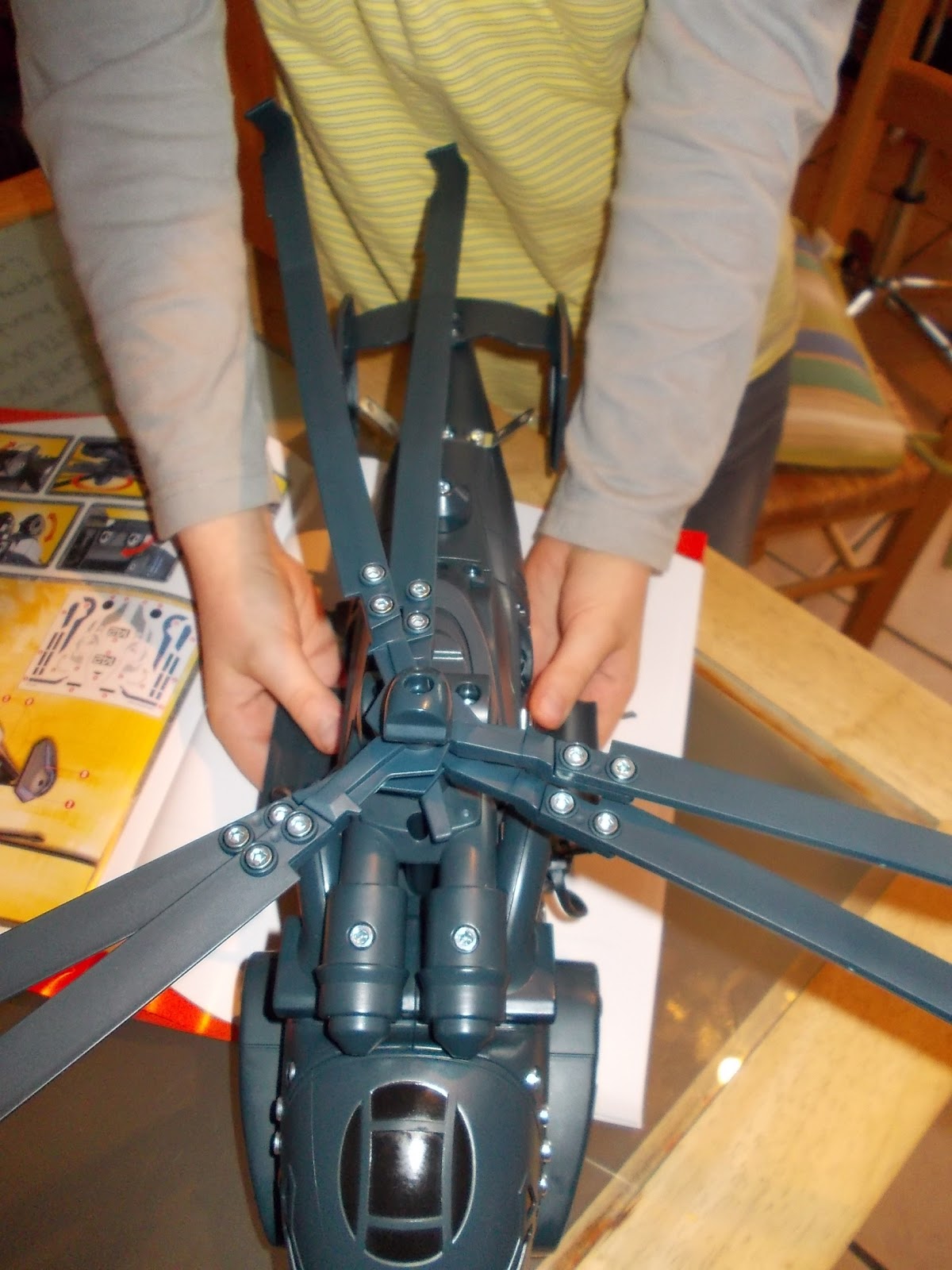 |
| Ta dah! |
 |
| This is bigger than I expected. |
Disclosure - We were sent the meccano for free but these are our own views and pictures. No fee has been paid for this blogpost. Many thanks to Liz and Meccano UK.
Sunday, 11 November 2012
Reasonable Adjustments - Part One

Clothing ideas:-
- Poppered trousers - if possible we buy trousers with popper instead of buttons. Where these aren't available, the trousers are altered to add a press fastener/ popper closure.
- Elasticated waists - where we can, we source trousers with adjustable elastic waistbands. This allows J to pull the garment down/ up more easily without the need for help. He is a thin lad so we also use the elastication to ensure he has the right leg length by pulling in the waist to fit. The TU range at Sainsbury's is good for this, as are some GAP and Next clothing lines.
- Lined trousers - J is somewhat picky about the feel of clothing (understatement). He likes Boden lined trousers but they are quite pricey. We try to buy in the sale when we can as he does particularly like their jersey lined skate pants... even though the waist size appears quite generous on him. Pumpkin Patch also do lined trousers that he will wear.
- Velcro fastenings - these are really useful on all sorts of clothing and footwear. Particularly good for outdoor wear. When J's hands become cold or if he is in a hurry he becomes less dextrous and velcro allows him to be self sufficient (most of the time).
- Over-the-head outerwear - this was a real life saver at school as J rarely had the time/ability to sort out zip closures for himself. The combination of jostling, dark changing rooms and the need for speed meant J was usually outside at playtime in all weathers whilst wearing a gaping coat. When we needed it, Boden had some fab half zip waterproof tops which were fleece lined so met J's need for 'something soft' too. Not sure they have them now though.
- Ski mittens - far easier to put on when your hands are cold or dexterity is limited. Many also come with 'little hooky things' which means J has less chance of losing one (mind you, they don't stop him losing the pair!!)
- Contrast colour toe and heel socks - these allow J to see which way the socks should go on his feet. However, they are only an assistant, he will still wear socks with the heel bit at the front.
Sunday, 4 November 2012
Meandering through Motor 'skills'
Where to start with this post? First of all, this is not a comprehensive guide into motor skills, as the title suggests, it will be a meandering account of things we've tried/are trying with J. We embarked on the wanderings in the knowledge that with strong gross motor skills, fine motor skills follow and with that the seemingly all important handwriting will emerge. The trouble for us is that with J his gross motor skills, at 12, remain poor (although they have improved greatly and he has worked long, and hard, to master things.) There is so much to say and cover that bite-sized posts may be the only way to go. We have tried/employed/practised many, many, many items/programmes/techniques in the hope of finding out what works for J.
J has struggled all of his life with handedness (this was touched on in an earlier post - What about Writing)... he showed no preference as a youngster so, given his other difficulties, it was agreed to encourage him to use his right hand. Now, this has made little difference. Being brutally frank, he is the opposite of ambidextrous, that is he is equally poor with both hands! We now know this is called being 'ambisinistrous'.
 As said in the aforementioned earlier post, J has had access to all types of pens, grips, writing slopes, white boards, therapy putty, paints, brushes, gross and fine motor games and exercises. All to very little avail. However, the facts remain that he has little stamina, holds implements at odd angles, cannot align his physical output with his mind's eye picture of what he wants to deliver... so you can imagine the frustration he feels. In the family, we call this his frustration gap and we try to encourage him to keep putting pen to paper with simple dot-to-dots, line games, letter formation games and so on.
 Some of the pens we have in our arsenal of handwriting tempters... he tends towards those with fatter grips and that can be corrected. So, the frixion pen was a real find - it writes like a roller ball yet rubs out like a pencil. The Stabilo s'move range are brilliant for reminding him where his fingers need to be to hold the pen/pencil. And the selection of felt tipped pens he has used is vast.
Over the years, although he has poor hand eye co-ordination J has adored Hama beads and is a still a keen beader. There has been the odd disaster when his masterpiece hasn't made it to the ironing board for fusing before a tremor has jerked the beads all over the floor. He loves telling the story of when he was trying to open a packet of beads (5000 of them) and was tugging at the packaging whilst saying "Mum, can you help me open - oooooops!" and lo!, there were 5000 beads spread far and wide across the floor. Whoops. We both had to laugh but my goodness they can't half travel.
Naturally, he's also been very much into Lego and Meccano and comes up with some massively complex creations. All of which have added to his fine motor skills and co-ordination/planning. He has a huge collection of Lego... dreams of the stuff and talks about 'improvements' to the current range of models he's working on. Lego is great for him... he gets to express himself, can (usually) do all his Legoing by himself and the models are quite sturdy so withstand any unexpected tremors. Of course, sometimes a 'disastrous' failure happens and it will require immediate re-building of the model 'just the way it was'. Meccano is a bit more structured, the instruction leaflets great for planning and the skill required to use the bolt/nuts in situ is one he's starting to master.
Work on gross motor skills happens throughout every day. J will catch and throw (socks usually) and can even bounce a mid-sized ball and walk with it a few steps now. He will jump off steps (only up to 4) to get feedback and 'ground' himself. He balances on a gym ball or physio roll (peanut) when he watches television so he knows where his body is... He's on the move all the time. In summer he will bounce on the trampoline. He has a swing seat indoors and loves to use that to calm down - but it also lets him know where his 'bits and bobs' are. More to follow on this in a later post...
J has struggled all of his life with handedness (this was touched on in an earlier post - What about Writing)... he showed no preference as a youngster so, given his other difficulties, it was agreed to encourage him to use his right hand. Now, this has made little difference. Being brutally frank, he is the opposite of ambidextrous, that is he is equally poor with both hands! We now know this is called being 'ambisinistrous'.
 As said in the aforementioned earlier post, J has had access to all types of pens, grips, writing slopes, white boards, therapy putty, paints, brushes, gross and fine motor games and exercises. All to very little avail. However, the facts remain that he has little stamina, holds implements at odd angles, cannot align his physical output with his mind's eye picture of what he wants to deliver... so you can imagine the frustration he feels. In the family, we call this his frustration gap and we try to encourage him to keep putting pen to paper with simple dot-to-dots, line games, letter formation games and so on.

Over the years, although he has poor hand eye co-ordination J has adored Hama beads and is a still a keen beader. There has been the odd disaster when his masterpiece hasn't made it to the ironing board for fusing before a tremor has jerked the beads all over the floor. He loves telling the story of when he was trying to open a packet of beads (5000 of them) and was tugging at the packaging whilst saying "Mum, can you help me open - oooooops!" and lo!, there were 5000 beads spread far and wide across the floor. Whoops. We both had to laugh but my goodness they can't half travel.
Naturally, he's also been very much into Lego and Meccano and comes up with some massively complex creations. All of which have added to his fine motor skills and co-ordination/planning. He has a huge collection of Lego... dreams of the stuff and talks about 'improvements' to the current range of models he's working on. Lego is great for him... he gets to express himself, can (usually) do all his Legoing by himself and the models are quite sturdy so withstand any unexpected tremors. Of course, sometimes a 'disastrous' failure happens and it will require immediate re-building of the model 'just the way it was'. Meccano is a bit more structured, the instruction leaflets great for planning and the skill required to use the bolt/nuts in situ is one he's starting to master.
Work on gross motor skills happens throughout every day. J will catch and throw (socks usually) and can even bounce a mid-sized ball and walk with it a few steps now. He will jump off steps (only up to 4) to get feedback and 'ground' himself. He balances on a gym ball or physio roll (peanut) when he watches television so he knows where his body is... He's on the move all the time. In summer he will bounce on the trampoline. He has a swing seat indoors and loves to use that to calm down - but it also lets him know where his 'bits and bobs' are. More to follow on this in a later post...
Sunday, 28 October 2012
Looking at Laces


In the past, the Clarks online ordering of boots and collection/purchase post-fitting in store has worked well - but not this time. Boots are only available in the winter season and unfortunately they don't offer any boots in an H fitting which is required by J. So, we had to find a different solution. When J was seen by the podiatrist at Great Ormond Street Hospital earlier in the year, she suggested that Timberland boots were something we could try. A quick internet search revealed a pair of these boots that met all requirements bar the velcro fastening. The boots were ordered and collected, had their insoles removed and J's orthotics inserted. It was looking positive as the insoles fitted the length of the boot well. Then J shoehorned his feet into the boots (literally) - he finds using a long, from Ikea, shoehorn the best way to get his feet into boots. Then came the laces. He was not happy to see them but, with a little lateral thinking on my part, they became acceptable to him.
 I sourced a couple of lace toggles/locks and cap/end covers. (search on ebay for cord locks or spring toggles).

 Here's what I did. I inserted the laces in a toggle, added an end cap and tied the lace ends before pulling the cap down. Not a perfect solution to tying the laces but at least J can make a good attempt at putting his boots on himself and we can check the tightness/fit prior to going out. Result. Quicker for us all with J having his own way to manage putting boots on.

Subscribe to:
Posts (Atom)